






Now you’re playing with …
dyce – Simple Python tools for exploring dice outcomes and other finite discrete probabilities
💥 Now 100% Bear-ified™! 👌🏾🐻 (Details below.)
dyce is a pure-Python library for modeling arbitrarily complex dice mechanics.
It strives for compact expression and efficient computation, especially for the most common cases.
Its primary applications are:
- Computing finite discrete probability distributions for:
- Game designers who want to understand or experiment with various dice mechanics and interactions; and
- Design tool developers.
- Generating transparent, weighted random rolls for:
- Game environment developers who want flexible dice mechanic resolution in, e.g., virtual tabletops (VTTs), chat servers, etc.
Beyond those audiences, dyce may be useful to anyone interested in exploring finite discrete probabilities but not in developing all the low-level math bits from scratch.
dyce is designed to be immediately and broadly useful with minimal additional investment beyond basic knowledge of Python.
While not as compact as a dedicated grammar, dyce’s Python-based primitives are quite sufficient, and often more expressive.
Those familiar with various game notations should be able to adapt quickly.
If you’re looking at something on which to build your own grammar or interface, dyce can serve you well.
dyce should be able to replicate or replace most other dice probability modeling tools.
It strives to be fully documented and relies heavily on examples to develop understanding.
dyce is licensed under the MIT License.
See the accompanying LICENSE file for details.
Non-experimental features should be considered stable (but an unquenchable thirst to increase performance remains).
See the release notes for a summary of version-to-version changes.
Source code is available on GitHub.
If you find it lacking in any way, please don’t hesitate to bring it to my attention.
Installation
Installation can be performed via PyPI.
1 2 | |
Alternately, you can download the source and install manually.
1 2 3 4 5 | |
Requirements
dyce requires a relatively modern version of Python:
It has the following runtime dependencies:
optypefor proper static and runtime numeric type-checking
dyce will opportunistically use the following, if available at runtime:
- NumPy to supply
dycewith an alternate random number generator implementation - Matplotlib for basic visualization helpers via
dyce.viz
See the hacking quick-start for additional development and testing dependencies.
Design philosophy
dyce is fairly low-level by design, prioritizing ergonomics and composability.
It explicitly avoids stochastic simulation, but instead determines outcomes through enumeration and discrete computation.
That’s a highfalutin way of saying it doesn’t guess.
It knows, even if knowing is harder or more limiting.
Which, if we possess a modicum of humility, it often is.
Quote
“It’s frightening to think that you might not know something, but more frightening to think that, by and large, the world is run by people who have faith that they know exactly what is going on.”
—Amos Tversky
Because dyce exposes Python primitives rather than defining a dedicated grammar and interpreter, one can more easily integrate it with other tools.1
It can be installed and run anywhere2, and modified as desired.
On its own, dyce is completely adequate for casual tinkering.
However, it really shines when used in larger contexts such as with Matplotlib or Jupyter or embedded in a special-purpose application.
In an intentional departure from RFC 1925, § 2.2, dyce includes some conveniences, such as minor computation optimizations (e.g., the H.lowest_terms method, various other shorthands, etc.) and formatting conveniences (e.g., the H.probability_items and H.format methods).
A taste
dyce provides several core primitives.
H objects represent histograms for modeling finite discrete outcomes, like individual dice.
P objects represent pools (ordered sequences) of histograms.
expand for mechanics that include dependent variables.
1 2 3 4 5 6 7 8 9 10 11 12 | |
1 2 3 4 5 6 7 8 9 10 11 | |
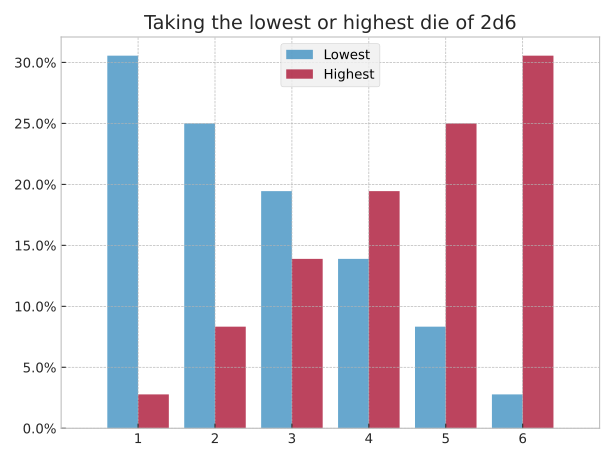
By providing an optional argument to the P.h method, one can “take” individual dice from pools, ordered least to greatest.
(The H.format method provides rudimentary visualization for convenience.)
1 2 3 4 5 6 7 8 9 10 11 12 | |
1 2 3 4 5 6 7 8 9 10 11 12 | |
H objects provides a probability_items method to ease integration with plotting packages.
dyce.viz provides Matplotlib-based visualization conveniences.
anydyce provides additional interactive visualization tools.
1 2 3 4 | |
Visualization: 
1 2 3 4 5 6 7 8 9 | |
H objects and P objects can generate random rolls.
1 2 3 | |
1 2 3 4 | |
See the tutorials on counting as well as the API guide for much more thorough treatments, including detailed examples.
Other efforts
dyce’s goal is to provide ergonomic and idiomatic Python interfaces to reasonably efficient discrete probability computations useful for gaming with minimal dependencies.
Consider exploring the applications and translations for added color.
But dyce does not stand alone.
Other works include:
- The OG
dice_roll.pyby Ilmari Karonen icepoolby Albert Julius Liu- GNOLL by Ian Hunter
- lea by Pierre Denis
- dice by Sam Clements
- ossuary by B. Szonye
- PythonDice by Ar-Kareem
- dice-notation by Bernardo Martinez Garrido
- Avrae’s d20 by Andrew Zhu
- python-dice by Mark Robson
- DnDice by “LordSembor”
- AnyDice (closed source) by Jasper Flick
Please consider contributing an issue if you observe discrepancies or think something should be added to the list.
Donors
When one worries that the flickering light of humanity may be snuffed out at any moment, when one’s heart breaks at the perverse celebration of judgment, vengeance, and death and the demonizing of empathy, compassion, and love, sometimes all that is needed is the kindness of a single stranger to reinvigorate one’s faith that—while all may not be right in the world—there is hope for us human beings.
- David Eyk not only inspires others to explore creative writing, but has graciously ceded his PyPI project dedicated to his own prior work under a similar name.
As such,
dyceis now available asdycelibdyce! Thanks to his generosity,millionsdozens of futuredyceusers will be spared from typing superfluous characters. On behalf of myself, those souls, and our keyboards, we salute you, Mr. Eyk. 🫡
Customers 
- This could be you! 👋
Do you have a project that uses dyce?
Let me know, and I’ll promote it here!
And don’t forget to do your part in perpetuating gratuitous badge-ification!
1 2 3 4 | |
1 2 3 4 5 6 7 8 9 | |
1 2 3 4 5 | |
License
dyce is licensed under the MIT License.
See the included LICENSE file for details.
Source code is available on GitHub.
-
You won’t find any lexers, parsers, or tokenizers in
dyce’s core, other than straight-up Python. That being said, you can always “roll” your own (see what we did there?) and lean ondyceunderneath. It doesn’t mind. ↩ -
Okay, maybe not literally anywhere, but you’d be surprised. Void where prohibited. Certain restrictions apply. Do not taunt Happy Fun Ball. ↩
